Personal Caregiver Resume Examples and Templates
Write a convincing Personal Caregiver resume by using our free resume examples. These samples are tailored for Personal Caregiver and written by a CPRW.
Create your resume
Select from 8 professional resume templates
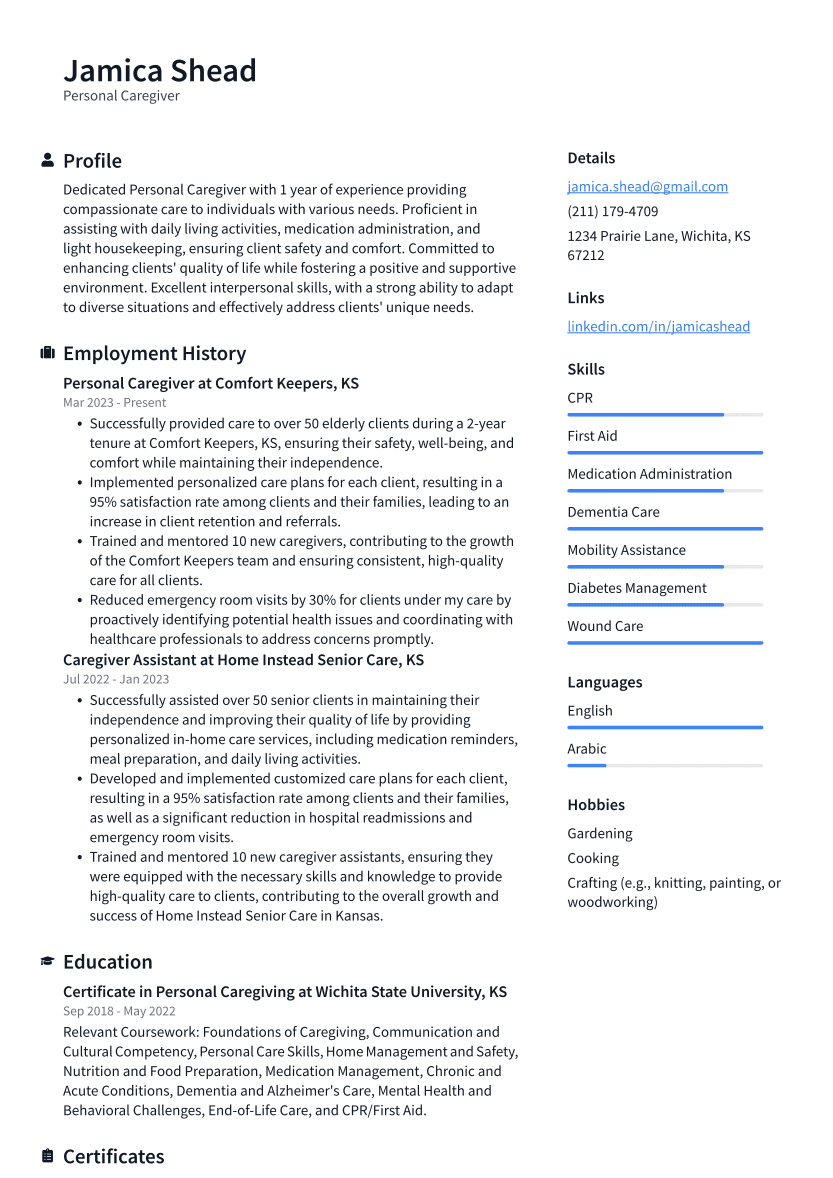
Essential Components of a Personal Caregiver Resume
A well-crafted resume is essential for a personal caregiver, showcasing your skills, experience, and qualifications. It represents your professional persona to potential employers and highlights your ability to perform caregiving tasks such as assisting with personal hygiene, meal preparation, medication administration, and companionship.
Your resume should include specific sections tailored to the caregiving role you're applying for. Understanding these sections, their significance, and how to make them stand out can significantly increase your chances of securing a rewarding caregiving position.
1. Contact Information
Your Contact Information should be prominently placed at the top of your resume. This section includes essential details employers need to reach you for further discussions or interviews.

Include your full name, phone number, and a professional email address. Optionally, you may add your home address, particularly if proximity is a job requirement. In today's digital age, some opt to omit their address for privacy reasons.
Consider adding links to professional online profiles, such as LinkedIn, or a personal website that showcases your caregiving expertise, if relevant.
- Full Name
- Phone Number
- Email Address (Professional)
- Home Address (Optional)
- LinkedIn Profile (Optional)
- Personal Website (Optional)
Ensure your contact information is accurate and up-to-date to avoid missing out on potential opportunities.
2. Objective Statement
The Objective Statement introduces you to potential employers and summarizes your career goals. It should express your passion for caregiving and highlight your key skills and qualifications.
An effective objective statement is concise and tailored to the specific caregiving role. For example: "Dedicated caregiver with over five years of experience in personal care services, seeking a position to utilize my skills in assisting elderly clients with their daily activities."
Write an objective statement that aligns with the employer's needs and captures their attention, prompting them to read further.
3. Skills and Competencies
The Skills and Competencies section is where you detail your relevant caregiving abilities. It should include both technical skills related to caregiving tasks and soft skills that facilitate effective patient care.
- Technical Skills: Knowledge of basic medical procedures, use of medical equipment, medication administration, dietary planning, and hygiene assistance.
- Soft Skills: Patience, empathy, communication, problem-solving, and emotional support.
- Organizational Skills: Scheduling, medication management, and health progress tracking.
- Physical Stamina: Ability to perform physically demanding tasks such as lifting patients.
- Emergency Response: Proficiency in first aid and CPR.
- Cultural Sensitivity: Respect for diverse backgrounds and customs.
Provide examples of how you've applied these skills in past caregiving roles. Tailor this section to match the job description's requirements.
4. Work Experience
The Work Experience section outlines your previous caregiving roles, responsibilities, and achievements. List each position with the job title, employer, location, and dates of employment.
Describe your duties and any positive outcomes from your care, using quantifiable achievements when possible. Highlight instances where you went above and beyond, such as implementing new procedures or receiving commendations for excellent care.
Include any relevant non-caregiving experience that has equipped you with transferable skills.
5. Education and Certifications
The Education and Certifications section validates your formal training and qualifications. List your educational background, starting with the highest level of education, and any specialized caregiving training or certifications, such as CPR and First Aid, Certified Nursing Assistant (CNA), or specialized training for conditions like Alzheimer's disease.
Professional certifications, such as Certified Home Health Aide (CHHA) or Certified Personal Care Assistant (CPCA), demonstrate your commitment to the caregiving profession.
6. References
References provide potential employers with insights into your capabilities and character from credible sources. Choose references who can vouch for your caregiving skills and work ethic, such as former clients, healthcare employers, or colleagues.
Always ask for permission before listing someone as a reference and provide them with your resume for context. If space is limited, you can state "References available upon request" and have a separate reference sheet prepared.
7. Personal Attributes/Soft Skills
Highlighting Personal Attributes or Soft Skills on your resume demonstrates your interpersonal abilities and emotional intelligence, which are crucial in caregiving. Include traits such as compassion, patience, communication skills, dependability, problem-solving, physical stamina, attention to detail, adaptability, emotional resilience, and a respectful and professional attitude.
These soft skills underscore your suitability for the role and your understanding of the demands of a Personal Caregiver.